Category Archives: moral sense

From Morality to Biology: punishment, deterrence, fairness and testosterone

It has been hypothesized, as per Game Theoretical models, that evolution of cooperation is contingent on there being people willing to inflict punishment on the cheaters/ free loafers , even at great cost to themselves. The presence of Altruism/ co-operation in human social groups suggests that the desire to inflict punishment has been selected for and is thus a part of humans nature.
In the psychological analysis of law, it has been debated for some time as to why all human societies punish their ‘criminals’. The two opposing views are that punishment is a deliberative , rational action whose purpose is to deter other potential criminals; and that punishment is an emotional action due to moral outrage and accompanied with feelings of ‘just desserts’ and desire for justice or fairness.

Do You Mind blog has a great post reviewing a study by Carlsmith, Darley & Robinson (2002), in which they try to find why people punish- is it to deter; or is it due to moral outrage and to get even.

The hypothesis was that if punishment is for deterrence, it would be more severe for crimes that are rarely detected (to compensate for the fact that the crime is rare, the punishment should be high); also for high publicity crimes, the punishment should be high (as the crime draws more attention, thereby punishing it severely will deter more people and from other crimes too). also if the punishment was motivated by desire for revenge/ justice, the severity of punishment should be correlated with severity of crime and publicity or detection of crime should have no effect. Also extenuating circumstances should excuse people if the desire is for justice/ fairness.

Accordingly, the authors set out to test how much of an influence deterrence really had. To do so, they designed a series of experiments using narratives of crimes where the above attributes (detection rate, publicity, magnitude of harm and extenuating circumstances) were varied. They found that manipulation of the deterrence variables had no effect, but that increasing the magnitude of harm or decreasing the extenuating circumstances greatly influenced the severity of punishment, even for those subjects who explicitly stated their preference for deterrence over “just deserts” theories of punishment.

This is an important validation of the fact that people do punish and that it is due to emotional and moral outrage and not based on coll and rational thinking based on deterrence. Thus, it seems for evolution of co-operation, we have been hard-wired to detect cheaters and to punish them and this is done without analytical deliberation but automatically.

Another article in the New Scientist , takes this one step forward and looks at motivations and mechanisms behind why we punish. The researcher, Terry Burnahm, asks the question as to why people indulge in a punishment behavior, though the punishment comes with a cost to themselves. Is it driven by a moral sense outrage, a desire for fairness or due to some other biological mechanism. The paradigm they use is the ultimatum game, wherein one person is given some money (say 10 $) and he is supposed to share it with another person. If the second person accepts the money, both get to keep the money; else both lose their money. Experimentally it is found that if low offers are made (say 1 $), they are usually rejected by the second person. This is due to the fact that the second personal wants to punish the first person for making an unfair offer.

What Terry discovered was that the propensity to refuse low offers was correlated with testosterone levels in males. Testosterone levels have also been correlated with aggression in the past and with dominance seeking behavior. The author suggests that the high testosterone connection is due to dominance seeking behavior of humans and by refusing to accept the low bet, the male saves putting himself in a subordinate position. It is presumed that this was beneficial in evolutionary times and thus has been selected for.

An alternative hypothesis can be that though the desire for revenge, just desserts or fairness is present in all humans, the ability to act on that desire is correlated with the aggression level or the level of testosterone. If this is the case, then the high levels of testosterone in males who retributed could be due to their moral outrage and their aggressiveness enabling them to act on their moral outrage. thus, in my view, the study , though finding a biological correlate, does not negate the scope for moral outrage, as increasingly it has come to be recognized that morality itself is emotional and more instinct like and not deliberative.

Moral Reasoning: two competing processes for intention and outcome identified

In a recent study, by Young, Hauser et al at the Harvard University, the authors tried to experimentally determine whether there is an interaction between intention or belief regarding an action vis-a-vis the actual outcome of the action. For this they used fMRI scans in a 2×2 study involving (negative and neutral) beliefs versus (negative and neutral) outcomes wherein their could be four combination : (competent criminal) intent to harm plus actual harm; (incompetent criminal) intent to harm but no actual harm; (accidental harm) no intent to harm but actual harm and lastly (harmless act) neither intention to harm nor any actual harm. The figure below clarifies this in further detail using an example scenario that was presented to the participants and the participants asked to judge whether the conduct was proper or not and to judge the protagonist’s action on a scale of 1..5 regarding whether it was morally permissible or not.

Before I proceed further I’ll like to quote from the introduction :

In the common law tradition, criminal conviction depends on both a harmful consequence (actus reus) and the intent to harm (mens rea) . In violation of this foundational legal principle, however, are crimes of attempt. The incompetent criminal, for instance, who believes he has poisoned his victim but has instead administered only a harmless substance, can be convicted in a court of law. This poses a challenge to the philosophy of law: is the basis of criminality an act that causes harm, or an act undertaken with the belief that one will cause harm? We pursue a novel approach to this question based on the burgeoning research into the neurocognitive mechanisms of moral judgment, much of which has emphasized the role of multiple interacting systems . Specifically, we suggest that the apparent philosophical conflict between actus reus and crimes of attempt reflects the operation and integration of distinct mechanisms responsible for the processing of information about consequences and beliefs in the service of moral judgment.

To sum up the papers’ findings:

1. They referred to earlier developmental results in children and adults that suggest that children form moral judgments on the basis of outcomes (they will condemn a negative act even if the intention was neutral or even positive) while in adults intention along with outcomes is taken into consideration to form moral judgments.

From a developmental perspective, integrating information about mental states and outcomes presents a particular challenge for young children. When moral scenarios present conflicting information about the outcome of an action and the intention of the actor, young children’s moral judgments and justifications are determined by the action’s outcome rather than the actor’s intention . For example, a person who intends to direct a traveler to the right location but accidentally misdirects him is judged by young children to be “naughtier” than a person who intends to misdirect a passerby but accidentally directs him to the right place . As children mature, they become progressively more likely to make the opposite judgment . Although subsequent research has revealed that young children can use information about intentions to make moral distinctions when consequences are held constant between scenarios , older children have consistently shown greater sensitivity to information about intentions. What develops then is not just “theory of mind,” or the ability to represent the mental states of others, but the ability to integrate this information with information about consequences in the context of moral judgment . Developmental evidence thus suggests that mature moral judgments depend crucially on the cognitive processes responsible for representing and integrating information about beliefs and outcomes.

2. They found using fMRI scans that the Right temporo-parietal Junction (RTPJ) was differentially engaged during the above four cases or combinations of intent and outcome. In particular RTPJ showed maximum activation in cases of attempted harm wherein intention to harm was present but the outcome was still positive. The participants condemned the action despite there be no actual harm and this was reflected in higher activations of RTPJ. It is instructive to note the RTPJ is responsible for belief attributions. Thus, this suggests that there are independent moral judgment functions- one dependent on actions and the other on outcomes.

At the broadest level, the results of the current study suggest that moral judgments depend on the cognitive processes mediated by the RTPJ, previously associated with belief attribution, and, to a lesser extent, the PC, LTPJ, and MPFC, which compose a network of brain regions implicated in theory of mind. Specifically, the results reveal significantly above-baseline activation of the RTPJ for all four conditions (intentional harm, attempted harm, unknowing harm, and all-neutral), highlighting the role of belief attribution during moral judgment. Importantly, however, brain regions involved in belief attribution were not recruited indiscriminately across conditions. In particular, we found a selective increase in the response for the case of attempted harm, in which the protagonist believed that he would harm someone but in fact did not. The differential neural response between experimental conditions suggests an unequal contribution of belief attribution to moral judgment depending not only on what the protagonist believes, as might be expected, but also on the consequences of the protagonist’s behavior. This result offers a new perspective on the integration of information about beliefs and consequences in moral judgment, the focus of our discussion.

3. They found that accidental harm (unlucky innocents) did not recruit the same brain areas (RTPJ) to that large an extent as attempted harm (incompetent criminal). This was despite the protagonists being judged harsher in accidental harm condition vis-a-vis the neutral case (no bad intention and no actual harm). This suggests that another independent moral judgment function is active and which relies on outcome assessment.

The behavioral data suggest that, across conditions, moral judgment is determined primarily by belief information, consistent with the robust RTPJ response for all four conditions. An interesting asymmetry emerged, however, for cases in which belief and outcome information were in conflict, as in situations of attempted harm and unknowing harm. We found that subjects’ moral judgments were determined solely by belief in the case of attempted harm but not unknowing harm. That is, attempted harm (e.g., putting sugar in a friend’s coffee believing it to be poison) was judged fully forbidden, just as though the protagonist had successfully produced the negative outcome of the friend’s death. By contrast, moral judgment of unknowing harm appeared to depend on both the outcome of the action and on the belief state of the actor. Unknowing harm (e.g., putting poison in a friend’s coffee believing it to be sugar) was not judged fully permissible, as compared with the all-neutral condition, in which the protagonist held a neutral belief and produced a neutral outcome.

I find this exciting because I have blogged about this previously in my posts relating to Universal Moral Grammar. In particular I had speculated on there being an Intention predicate, an Action Predicate and a Outcome or Consequence predicate that form this moral grammar. These predicates would each be evaluated separately and independent of each other and their combination would lead to different moral judgments. It is exciting to see that two independent processes related to Intention and Outcome predicate , along with their neural correlates have already been identified. It would only be some time soon that people would also start finding that the nature of the Action undertaken also affects the Moral Judgment to a great extent. The case I can think is that instead of putting poison in the coffee, let us say that the death method was more violent and gory (cutting the throat very slowly while the person is bound). Although the outcome is same, the nature of action would differentially affect the judgments we have towards the protagonists. I would love to see further studies in this direction.

The origins of Morality

There is a decent article in NYT that explores the work of Dr. Frans De Waal and his assertion that the root of human morality is grounded in the sociality exhibited by the primates. His contention is that animals (esp Apes and Monkeys) show emotions and empathy; as well as for the evolution of co-operative behavior many other factors underlying Morality- like reciprocity and peace-making evolved and these in turn set up the stage for the evolution of Human morality.

Social living requires empathy, which is especially evident in chimpanzees, as well as ways of bringing internal hostilities to an end. Every species of ape and monkey has its own protocol for reconciliation after fights, Dr. de Waal has found. If two males fail to make up, female chimpanzees will often bring the rivals together, as if sensing that discord makes their community worse off and more vulnerable to attack by neighbors. Or they will head off a fight by taking stones out of the males’ hands.

Macaques and chimpanzees have a sense of social order and rules of expected behavior, mostly to do with the hierarchical natures of their societies, in which each member knows its own place. Young rhesus monkeys learn quickly how to behave, and occasionally get a finger or toe bitten off as punishment. Other primates also have a sense of reciprocity and fairness. They remember who did them favors and who did them wrong. Chimps are more likely to share food with those who have groomed them. Capuchin monkeys show their displeasure if given a smaller reward than a partner receives for performing the same task, like a piece of cucumber instead of a grape.

These four kinds of behavior — empathy, the ability to learn and follow social rules, reciprocity and peacemaking — are the basis of sociality

While it is still contentious as to what extent Morality is inbuilt (genetic and one of the human universals) versus it develops under the influence of society and is culturally determined; the actual case, like everything else, may lie in between in terms of a developmentally unfolding of inherent potentiality and with various nuances as per the culture of flowering. Here Kohlberg’s developmental framework would seem relevant- but that framework is too much Kantian in the sense that it emphasizes, and is based on, rational reasoning. The reality may however be as more Humean and as per De Waal and Hauser, whereby most moral decisions are more intuitively guided, with post-hoc reasoning following the initial emotional decision.

But biologists like Dr. de Waal believe reason is generally brought to bear only after a moral decision has been reached. They argue that morality evolved at a time when people lived in small foraging societies and often had to make instant life-or-death decisions, with no time for conscious evaluation of moral choices. The reasoning came afterward as a post hoc justification. “Human behavior derives above all from fast, automated, emotional judgments, and only secondarily from slower conscious processes,” Dr. de Waal writes.

I, of course am most sympathetic to the developmental framework and hope that someone would take up Kholberg’s framework and incorporate emotions and emotional intelligence in it.

The Mind – Brain dichotomy: What it means to have a mind

Researchers at Harvard, Gray et al, are conducting an ongoing mind survey, and have also reported some findings from that online survey, based ona asmaple of more than 2,000 people.

The survey attempts to make one think about different forms of entities that may have a mind and to assign different degrees of consciousness/ mind on them.

Gray worked alongside fellow psychologists Heather Gray and Daniel Wegner on the study, which presented respondents with 13 characters: 7 living human forms (7-week-old fetus, 5-month-old infant, 5-year-old girl, adult woman, adult man, man in a persistent vegetative state, and the respondent himself or herself), 3 non-human animals (frog, family dog, and wild chimpanzee), a dead woman, God, and a sociable robot.

Participants were asked to rate the characters on the extent to which each possessed a number of capacities, ranging from hunger, fear, embarrassment, and pleasure to self-control, morality, memory and thought. Their analyses yielded two distinct dimensions by which people perceive the minds of others, agency and experience.

The participants attribute different degrees of these factors to the characters based on a forced choice between a pair of characters on a particular ability related to a mind capacity like feeling fear or making moral decisions. I believe they than id factor analysis or some such statistical method to come up with two independent dimensions or factor underlying the concept of mind: Agency or Experience.

Agency seems to be related to the fact that people (entities with mind) can take volitional actions and are thereby responsible for their actions. They can thus also be judged morally based on their actions and the choices they make.

Experience seems related to the fact that people (entities with mind) have an ability to feel and are emotional entities that have subjective experience of emotions like pain, fear and hunger and also have desires, longings and feelings etc.

The ability to perceive qualia surprisingly didn’t come out as a separate entity and consciousness or ability to perceive qualia is supposedly covered under the Experience factor.

These dimensions are independent: An entity can be viewed to have experience without having any agency, and vice versa. For instance, respondents viewed the infant as high in experience but low in agency — having feelings, but unaccountable for its actions — while God was viewed as having agency but not experience.

“Respondents, the majority of whom were at least moderately religious, viewed God as an agent capable of moral action, but without much capacity for experience,” Gray says. “We find it hard to envision God sharing any of our feelings or desires.”

The regular readers of this blog will remember that one of the important distinction that I hypothesized between Schizophrenia and Autism was that due to agency: with schizophrenics attributing too much Agency; and Autistic attributing too less Agency to others (other people or other entities that may have mind). Also as God is perceived as having too much Agency, but not much Experience, thus when the Schizophrenia end of spectrum kicks in, they may also attribute too much agency to themselves and feel God-like or Divine. The negative symptoms related to less of experience would also fit the fact of being God-like or being an angel/ special person and thus not having too much emotions. The Autistic end of the spectrum however would be guided by too-less-mind sort of attributions and thinking; and thus they may view themselves and others as brains and not minds. They might thus be more capable with inanimate objects and rules of nature (thus making them good scientists/ engineers/ systemizers) ; but poor at social/ ethical aspects that require attributing minds to animals for example.

One should also distinguish between the two dimensions of Agency and Experience. Thus Autistic may have a defect due to Agency, but may have mirror neurons or other systems that confer on them the ability to feel , not only subjective feelings of self – but empathetic feelings of others too.

Also, it has been this blogs contention that the Dimension of experience is best seen as a dimension on one end of which is the Bipolar patients and on the other end of which is the Deprosanalisation/ apathetic / derealization spectrum. while the Bipolar feels too much emotions and motivations; the depersonalised/ derealized person may show too less emotion/ motivation.

Thus in mind at one end we have people having too much mind/ believing in too much mind (and exemplified by Schizophrenic and Bipolar ) and at the other end we have too people having too much brain/ believing in too much brain (exemplified by Autistic/ depersonalised people). One gives great Art, the other great Science.

Returning to the current study:

“The perception of experience to these characters is important, because along with experience comes a suite of inalienable rights, the most important of which is the right to life,” Gray says. “If you see a man in a persistent vegetative state as having feelings, it feels wrong to pull the plug on him, whereas if he is just a lump of firing neurons, we have less compunction at freeing up his hospital bed.”

This is exactly one of the pertinent point made by the film Munnabhai MBBS– that coma patients have feelings and have a right of life. While I have featured the effects of Lage Raho Munnabhai earlier; I would also like to pay tribute to its prequel/ precursor.

On that note, let us keep our antennas up for how thinking about us as entities with Agency and Experince can lead to Art; while thinking of us as brains can lead to good scince. I’m sure you’ll agree that we need both of these concepts about us humans.

Moral Intuitions: Musings continued.

In the last post, we dwelled on the classical trolley problem as well as a new type of moral dilemma that may be termed as the Airplane dilemma.

In some versions of the Airplane (as well as the Trolley ) problem, the problem is framed so as to implore us into examining our notions of trusting or being suspicious of strangers (terrorists scenarios) and to take into account the past as well as future characteristics of these people (like high IQ and national celebrity status) to arrive at a moral decision, as to serving whom would be a more moral action for the doctor. The airplane problem mostly focuses on Trust Vs Suspiciousness dimension, is people-centered and focuses on assessing people and situations correctly in a limited amount of time. After the decision is made, then the action is more or less straight-forward.

The trolley problem is also similar, but of a somewhat different nature. Here, the focus is on actions and outcomes. The Morality of action is judged by its outcome as well as other factors like whether the (in) action was due to negligence, indirect, personalty motivated etc. The people centered focus is limited to using-as-means versus ends-in-themselves distinction and in the later problems (president-in-the-yard) that of guilty vs innocent. The innocent, careful child playing on unused track, while the careless , ignorant five idiots playing on the used track is another variation that plays on this careful action versus careless action distinction.

It is my contention that while the Trolley problem aptly makes clear the various distinction and subtleties involved in an Action predicate, viz whether the action is intentional, whether it is accidental- and if so how much negligence is involved; whether (in)action could be prevented/ executed differently for different outcomes etc; it does not offer much insight on how to evaluate Outcome Predicate or the Intention Predicates.

In the Trolley Problem, while the intentional vs accidental difference may guide our intuition regarding good and evil , in case of positive or negative outcomes; the careful versus careless (negligent) action guides our intuitions regarding the normal day-to-day good and bad acts. Here a distinction must be made between Evil (intentionally bad outcome) versus Bad acts(accidental or negligent bad outcome).One can even make a distinction between Good acts (performed with good intentions) versus Lucky acts (accidental good outcomes, maybe due to fortuitous care exhibited). Thus, a child playing on an unused track may juts be a ‘bad’ child; but five guilty men tied on tracks (even by a mad philosopher) are an ‘evil’ lot. Our intuitions, thus , would be different in the two cases and would not necessarily be determined by utilitarian concerns like number of lives.

Some formulations of the airplane problem, on the other hand , relate to quick assessment of people and situations and whether to trust or be suspicious. The problem is complicated by the fact that should the doctor invest time in gathering more data/ confirming/rejecting her suspicion versus acting quickly and potentially aggravating the situation/ long-term outcome. These formulations and our intuitive answers may tell us more about the intention predicates we normally use. Whether we intend to be trusting, innocent and trustworthy or suspicious, cautious and careful. If cautious and careful, how much assessment/ fact gathering we must first resort to to arrive at the correct decision, before committing to single-minded and careful action.
Should we juts look at the past for arriving at a decision, or should we also predict the future and take that into account? If we do predict the Outcomes, then the Consequence predicate is long-term or short-term? Is it an optimistic or a worst-case outcome scenario?

There are no easy answers. But neither is the grammar of any language supposed to be easy. Constructing valid and moral sentences as per a universal moral grammar should be an equally developmentally demanding task.

Moral Intuitions (alternate title : Who framed roger rabbit?)

Disclaimer: Haven’t seen the movie “Who framed roger rabbit”, nor know the storyline- just used the alternate title as it is eye-catching:-))

Classical Moral intuitions research has focused on identifying how we arrive at moral conclusions. The Kohlberg’s developmental theory is based around identifying the reasoning process, by which, the children arrive at a moral decision regarding a moral dilemma; or identifying an action that would be ethical in a given situation; or forming a moral judgment regarding a given event-outcome.

Much of the discourse is limited by the few example problems around which these dilemmas are framed. A good example is the famous Trolley problem, in which one has to decide whether it would be worth sacrificing a single person, in lieu of five or six others; and its variations involving whether one is in direct contact with the person and is performing an active action of ‘sacrificing’ the person by pushing him/her from the footbridge; or is merely a bystander and passively (from a distance) pulling a switch that would direct the trolley to a different track. Variations include whether the person (who if sacrificed could save five or six others) is related to you, or whether he is innocent (a child playing on an unused track) vis-a-vis those being sacrificed are careless and thus not worth saving ( stupid children playing on running tracks).

While some framing of this Trolley problem are in utilitarian terms- one life versus many others, other framings are in emotional & selfish versus sacrificial & rational terms -your child or your action vs other children and universal action (by universal action I mean the same action irrespective of whether you are in touch with the person (the footbridge case) or are merely pulling a lever).

The framing involving ‘good/ careful’ vs. ‘bad/careless’ in the good-boy-on-unused-track and bad-boys-on-used-tracks fascinates me the most.

At the outset, let me clarify that in regards to moral dilemmas of this sort, my personal position is reasonably clear. In a discussion some years back with some good friends (not over a cup of coffee; but over an intranet discussion group:-) , while we were discussing this dilemma, I had surmised that while we may debate endlessly what the action should be, the most reasonable guess one can make is that there would be no action at all. In the Trolley switch case, this means that the person my get so much frozen by the decision pressure and inability to arrive at a conclusion, that he/she may not pull the switch at all (the switch that would direct the train/ trolley to the unused track ). Instead, he may just remain frozen- just like one gets frozen sometimes in times of extreme fear- a third reaction apart from the usual fight or flight response. Yet, dilemmas, such as these, and our ‘hypothetical’ responses to these may somehow tell us more about how we reason about moral situations- whether it is post hoc (just like it is claimed that Consciousness is post hoc)- and if so, why would we be constructing different post-hoc moral reasons for the same dilemma when it is framed in different terms. (Hauser’s research shows that the intuitions are different in the classical trolley (switch) versus the personal contact (footbridge) cases.)

Marc Hauser’s lab is doing some excellent research in this field and though I have taken their Moral Sense Test, I have a feeling that I have stumbled on a new type of framing and dilemma (that was not present in their tests…though one can never be sure:0) that may enable us to reflect a bit more on our moral reasoning process.

I’ll frame it first in neutral terms, and then try to refine it further. Let’s call this the Aeroplane problem. Suppose that you are traveling in an Aeroplane, and there is only one doctor present on board, and the Air hostess staff is not sufficiently educated in all first aids. Suppose further that you are way above ground, with any emergency landing at least 20 minutes distant. Suppose, that their are two people on the Airplane, who start getting a third heart attack (they are both carrying medical histories/ badges that tell that it is the third and potentially fatal heart attack (BTW, why is the myth of 3rd heart attack being fatal so enduring?) ), and the heart attacks are almost simultaneous, and only the lone doctor on board can give them the first-aid and resuscitation (CPR) that could ensure that they both remain alive, till the airplane makes an emergency landing (the emergency landing may itself risk the life of all passengers slightly). Now, when all other details are unknown, it is potentially futile to ask which one to attend- you may as well choose one patient and concentrate all efforts on him/her.

Suppose, one of them is an octogenarian, while the other is a teenager. Now, which one should the doctor choose? Suppose one is an old lady, while the other is a young brat, which one should the doctor choose?

Suppose the Doctor has Asthma, and no body else knows how to administer the oral inhalation medicine correctly except for the doctor; then should the doctor take care of a patient or should he/she take care of himself/herself? what if there is only one patient and one doctor? What if there is one doctor and many patients? Would the decision be easy?

Suppose further, that out of the two persons, one is faking heart attack symptoms, while the other is genuinely suffering; should the doctor be able to find out who is who? Would this make the dilemma easier? Would we (the airplane travelers) respect the doctor’s decision and let him /her attend to the person s/he thinks is genuinely suffering from heart attack?

Suppose further, that both the patients are terrorists and the doctor says that both are faking symptoms, potentially to hijack the plane; would we listen to the doctor and let him not attend to any of the potential causalities? Or would we try to help ourselves, potentially causing bedlam and fulfilling the plans of the terrorists?

I am sure by now you can conceive of other similar scenarios!! (one that comes to my mind is both the doctor and patient are accomplices and terrorists on-board to cause bedlam and mayhem and hijack the plane. Please let’s add as many scenarios in the comments as possible.)

Now let us take a moment to reflect on our moral reasoning process. I believe most of us would be prone to go with our intuitions and would think about rationalizing our decisions later. Thank god, we do have some moral intuitions to guide us in time of indecision/ threat perception.

Suppose that instead of framing the last few scenarios in an anxiety provoking setting (involving terrorists and what-nots), we framed this in terms of forward-looking, futuristic terms.

Suppose that one of the patients is a very promising child (has an IQ of 200/ or is a sport prodigy and is as well-known as Sania Mirza) while the other is again a famous scientist indulging in some ground-breaking research (Say Marie Curie, whose Radioactivity discovery is definitely a very useful discovery); then who should the doctor choose? Should she look at their achievements or potentials? Or should she remain immune to all this and dispassionately ignore all (ir)relevant information? or should s/he be affected by age, gender, race, achievement, potential etc?

Suppose further that instead of well-known celebrities like Abdul Kalam , or Sachin Tendulkar, who are present in the plane, the younger patient is a product of genetic engineering, destined to become a great scientist/ artist/ whatever; while the older patient is working on a top-secret classified dual use research which potentially could help humanity overcome the impending fuel crisis (and related arctic melting, ozone hole etc crisis-she is working on a hydrogen powered (water as fuel) engine, which could be used in automobiles as well as in outer Space like Mars, where only water may be available for refueling). Also, both these persons are not well-known currently and not recognizable by the doctor/ crew/ passengers. Death of the older person would put humanity back by at least 40 years- only after 40 years would someone like the younger patient that the doctor saved (in case the doctor let the older patient die), could have worked out the designs for using water as a fuel again. Now which one should the doctor attend to? Should s/he attend to the young one or the old one? The future or the present?

Should she take the time out to see the credentials (the proof that this child is genetically modified to have a good IQ/ whatever and the proof that this scientist is indeed working on classified research that may potentially help millions) of the patients or should she just act on her intuitions? Why is the reasoning different here as compared to the threat-scenario?

What if the instead of Science frames above, we used frames of Art(I mean artistic frames and not the frames that visual artists use for paintings:-)….Art is much more than visual art:-).

Suppose, that one of them (the older one) could become a Paul Gauguin; while the other (younger one) could become a Van Gogh (again I mean an artist like Gogh and Gauguin, not their works of arts:-) ), now which one should the doctor choose? Why does it become irrelevant as to who should be saved if the frame is of Art, but a question of life-and-death if the frame is of Science?

Finally, some things to note and think about: the Airplane problem is entirely framed in life-saving context (doctor helping save a life); while the Trolley problem is entirely in death-prevention context (someone acting messiah and preventing death of five Vs One; good vs careless etc). Again, Doctors usually give rise to feminine frames with one assuming a doctor to be a female; while the Foreman’s are usually entirely male. I hardly believe that framing is all of the problem; or that the framing is done deliberately: the framer of the problems/ dilemmas is equally susceptible to the same framing effects that the readers have experienced-while formulating a problem (a moral dilemma) one may fall prey to the same sorts of Frames that we become susceptible to when thinking about the problems (the moral dilemmas). Thus, the aphorisms, that (paraphrasing) “It is equally important to ask the right questions, as it is to find the answers to the problems”. Translated in the language of the scientific research world, this becomes that “it is important to design good experiments/ observation-study-setups and be very careful about the study designs.”

Returning back to the issue of framing of moral problems, if the frame exists it is also because of our history: just like the moral intuitions – that at times help us survive and at times let us fall prey to frames- are due to our shared evolutionary history: so too the frames we use to cast and perceive the moral dilemmas are rooted in our history ( Nothing profound- what I mean by shared history is that someone formulated the problems in those terms, silly!!.)

I believe the problem is more with our inability to detach ourselves form frames and take more reasonable perspectives and know when to use our intuitions and when reason. As the saying goes “It is by the fortune of God that, in this country, we have three benefits: freedom of speech, freedom of thought, and the wisdom never to use either.” Mark Twain (1835-1910). Alternately, another related saying that comes to mind(paraphrasing) ” God, give us the ability to change what we can, humility to accept what we cannot and the wisdom to know what is what”. We perhaps cannot change the historical frames or intuition that are in place, but we can definitely change our moral reasoning powers and following a developmental framework have compassion and understanding towards those who might not be employing the highest levels of moral reasoning.

Finally, If you are interested in my moral intuitions, I hypothesize, that the doctor (in the plane) would not be affected by Age, gender, race, potential, achievement etc would overcome his/ her Implicit Associations and would not try to find-out or gather-information deliberately to determine which life is more valuable- He/she would end up rushing between the patients and helping both at the same time; but if he/she is an intelligent doctor, would definitely save his/her life first, if suffering from Asthma, so that he/she could take care of others. This might seem like a rationalization (saving one’s life so that one can help in whatever small way others), but one should use intelligence, even before emotions or moral instincts take center stage.

I believe that in the Airplane Scenario described above, there is a potential for a histrionic/hysteric reaction of the crew and travelers, as everyone tries to help the patients, (especially if no doctor is on-board) and that this may be the reverse of the bystander-effect like phenomenon I have hypothesized might happen in the Trolley problem (freezing and taking no action when a train is approaching towards five or six humans or towards a lone human). To make more sense of preceding line please read comments by Mc
Ewen on Mind Hacks post titled ” “Mass Hysteria” closes school”. Also, a solemn and personal request, please do not jump to conclusions, read or try to co-relate things out of context- or try to make sense of psychological concepts based on everyday usage of terms. If you do not understand any concepts mentioned above, read related literature and focus on that aspect alone- to the exclusion of other distracting eye-catchers. In case of any persisting confusions, feel free to ask your local psychiatrist/ psychologist/ psychology professor as to what those concepts mean.

PS: I believe that the post has become difficult-to-read, this was not done intentionally. Again, there might be spelling mistakes/ grammatical errors- don’t get alarmed/ confused that this reflects racing thoughts etc- just point them out and I’ll fix them- most of the times the editorial errors (some of them quite funny) are due to lack of time to revise/ lethargy to read. Also, this is also a part of my ongoing series, where I have posited that their may be gender differences in cognitive styles. Some of that may also be a required reading.

Framing Effects in the Universal Moral Language

I have posted earlier about the similarities between the Universal Grammar concept associated with languages and the Universal Moral Grammar that Hauser has proposed. To take the analogy further, just as linguistic framing of a issue leads to different interpretations and effects in the person exposed to a sentence or a phrase or a discourse, so too it is apparent that when a moral dilemma is posed under different contextual situations or framed differently then they led to different appraisals by the same subject.

To begin with, one may note that Mixing Memory writes about the concept of personal and impersonal violations, as outlined by Greene et al, and associates them with the famous Moral Dilemma of one versus five lives on a railway track in two different conditions – the Footbridge and the Trolley. To explain the differences in responses of the people to the differing moral dilemma in the two conditions, the concept of impersonal and personal violations is introduced and it is posited that these involve different reactions in the brain – one utilizing the emotional brain, and the other a rational brain. However, I have elsewhere provided a more parsimonious explanation utilizing the stages of moral development that people are on and how that may lead to different outcomes for the same moral problem in the two conditions. Specifically those at stage 3 of good interpersonal relationship would differ in how they respond to the two dilemmas.

More relevant to our discussion here, is that the same effects could be explained by the differing framing of the Moral dilemma. In effect, the footbridge dilemma is framed in such a way as to activate the action predicate processing in a different way from the impersonal trolley condition. In the footbridge case, the action predicate is of an action involving two human beings- the action is deliberate pushing of another person- and hence of more negative connotation- than the corresponding impersonal action involving acting on an inanimate object- viz. pushing the trolley. Thus, when Action Predicate also becomes a significant player in the Moral Dilemma, then though the intention and consequence predicate may remain the same, it may lead to different evaluations of the Moral Sentence.

Second, one needs to pay attention to the effect of emotions that has been observed in the footbridge dilemma, as observed by Piercarlo Valdesolo and David DeSterno. They report that under positive affect, people are more apt to choose the more ‘rational’ utilitarian alternative of pushing the person down the footbridge. This clearly is due to different framing conditions. A big part of the Moral Language is definitely made up of affects as they often provide a reliable guide to instinctive moral behavior. Thus, b putting the subjects under positive affect may be tantamount to the same framing effects that are observed when concepts like Tax opposition are associated with happy sounding words like relief and thus frame the issue of taxation differently. By a similar sleight of hand, as humans do tend to associate happiness and ‘happiness for largest number of people’ in their mind, so the utilitarian ethic may dominate when the context surrounding the moral dilemma is of ‘happiness’ or positive affect. It remains to be seen, if arousing negative or other affects in the subjects lead to a decline in the utilitarian response.
Anyway, the results as they stand today, do not corroborate the Impersonal/Personal violation theory and the corresponding rational/emotional brain theory, because the results clearly show that the differential response when in positive affect footbridge condition is due to the different emotional significance attached to the dilemma in happy affect vs. neutral affect situations. If anything, in the happy affect situation, the affective influence in decision making was greater (as baseline emotional activity was greater), than in the control condition. To prove that rational decision making was strengthened in presence of positive affect, one would need to show a general increase in rational decision making when under positive affect, or if not, at least by taking MRI scan of these happy affect decision makers, show that rational brain centers were more engaged than emotional centers while making the happy-affect-utilitarian decision..

Till then, we have plenty of evidence supporting the other hypothesis that positive affect improves moral reasoning as positive affect may be an internal guide used for guiding moral action – if something feels good, then it perhaps is good. Case in point is studies that have earlier demonstrated that if a graduate student is in positive affect, then he/she is more likely to help strangers– for example by picking up dropped books. Thus, positive affect may be intrinsically linked to more altruistic/ moralistic actions and framing a dilemma, such that it arouses positive or negative affect in the subject, may alter the way the dilemma is perceived and resolved by the subject.

A Universal Moral Grammer: a case for Intention Predicates, Consequence Predicates and Action Predicates?

There is an interview of Mark Hauser on the American Scientist wherein Hauser discusses Moral Development in humans and animals in context of his soon-to-be-released book Moral Minds.

In brief, Hauser contends, that just like humans are born with an innate ability to acquire language and there exist universal grammatical rules underlying this language acquisition, so too there are universal, innate, unconscious moral rules and they govern the development of Moral Sense. Thus, though different languages may have different content (actual words etc), their form would be constrained by the Universal Grammar that was instrumental during the language acquisition, so too though different cultures may have different moral or ethical systems or values (the actual content), their form would be constrained by the universal, unconscious grammatical rules that constrained the development of that particular moral language.

To simplify things a bit, it is instructive to read up a bit on Universal Grammar as well as familiarize oneself with popular grammars like Generative grammars that are used in linguistics.

Hauser mentions that the “moral grammar is a set of principles that operate on the basis of the causes and consequences of action”. To put that in a simplified (and my own!) form, one may say that every moral sentence (or moral act/judgment) can be represented in the form of a Cause or Intention Predicate (IP), a Action Predicate (AP) and a Consequence Predicate (CP).

Thus, A Moral Sentence S consistent with a particular Moral System would have the form

S = IP AP CP

This is similar to a normal language sentence being of the form Noun Predicate followed by Verb Predicate followed by Prepositional Predicate (juts for sake of example)

The IP,AP and CP may themselves be recursively defined and may be made of either terminals are non-terminals like IP,CP, AP themselves.

Thus we may have different types of Moral languages – ranging from type 3 or regular moral languages to type 0 or unrestricted.

Only sentences that are valid and as per the rules of the Moral language would be ‘right’, while sentences that have been rejected by an automata as not belonging to that grammar would be ‘wrong’. Thus, an algorithmic implementation of judging acts as moral or immoral can exist.

Hauser, also mentions some interesting observations.

  • When consequences of an action are same, one (even children) differentiates based on whether the act (or lack of it!) was accidental or intentional.
  • If an act was accidental and leads to the same consequence, one still distinguishes whether the act was hasty, due to negligence or carelessness or something which normally should have been performed, but skipped.
  • He also discusses, that even when consequences and intentions are same, say in active and passive euthanasia; still based on the nature of act – viz. the fact that in former one is actively ending life by administrating poison, while in other one is passively letting the person die by removing life-support – our moral judgments are different.

Hauser doesn’t go on to develop from these observations a full-fledged universal Moral grammar, or maybe he does so in his book, but I take the liberty here to relate this to my own theories of Moral devlopment as well as my analysis of Kohlberg’s theory and see how this Universal Grammar affects the acquisition of Moral Sense in a developmental staged manner in Humans.

To make the analogy clear, consider language acquisition in Children. There is a clear developmental pattern to all language acquisitions and this is independent of the language learned. The child begins by babbling, follows up with one letter words (either nouns or verbs), then goes on to construct two letter words, this is followed by a telegraphic speech phase wherein multi-word sentences are created, but there is too much grammeticalisation and finally the adult usage of multi-word grammatically correct sentences that are pragmatically used.

Within these broad stages, there are universal features found in all languages like usage of inflection and intonation to denote exclamation or interrogation without changing the order or content of words used to denote a normal sentence. For example, normal sentences like

“Dad is coming”

when spoken with different inflections and intonations can either represent an exclamation or an interrogation viz.

“Dad is coming!”

or
“Dad is coming?”

This is true for all languages and this ability to use inflection also develops later and in a staged manner. Similarly prepositions are learned later than say nouns, verbs or adjectives in all languages.

To focus discussion back on Universal Moral Grammar and acquisition/development of Moral Sense, what I propose is that different stages of Moral development reflect the mastery of some rules of this universal grammar.

In stage I of Moral Development, one is babbling in the sense that one is trying to formulate a coherent moral judgment about any act. One has still not learned/ identified the ‘words’/ ‘acts’ that form the moral lexicon (of the moral culture in which this moral sense is developing) and as such judges an act based on whether it is personally rewarded or punished. One has started forming the concept of ‘consequence’ of an act, but that consequence is defined by how the society around us responds to a particular act, rather than on any intrinsic property of the act. The concept of Consequence Predicate is beginning to form and one starts judging an act based on the ‘good‘ or ‘bad’ consequence it had and this consequence is learned by feedback provided by society/parents.

In stage II of Moral Development, one is in the holophrastic speech stage in the sense that one has realized the acts that lead to good consequences and those that lead to bad and undesirable consequences. In this stage one may also start realizing the difference between accidental acts or intentional acts and value intentional acts over accidental ones. Still the child would be using either the schema of Intention or that of Consequence to judge an act. It may not be possible for him to combine the two schemas together and analyze the situation not only on the basis of consequences as well as on the basis of intentions.

In stage III of Moral Development, one may start combining two moral predicates like “Intention” and “Consequence” to form combinations and then judge whether the moral act is inline with his moral system or not.

For example, the terminals for Intention Predicate could be ‘good’, ‘bad’, ‘selfish’, selfless’, ‘accidental’, ‘active’, ‘casual’ etc and the terminals for Consequence Predicate could be ‘good’ , ‘bad’ , ‘maximising’ ,’minimising’ ,’disruptive’ ,’constructive’, ‘long-term’ etc

The combination of these two ‘words’ in stage III of Moral development may lead to different value judgments of a moral act, based on taking into account both the consequence and the intention.

In stage IV of Moral development, one may start refining the moral judgment statements, by taking into account Action Predicate terminals like ‘inactive’, ‘casual’, ‘careless’, ‘lazy’, ‘lethargic’, ‘vigorous’, ‘vibrant’, ‘thoughtful’ etc and combine these with IP and CP to form more complex 3 or more words sentences. One would also start refining IP, CP and AP as recursively embedded in each other and thus consisting of more than one words each, but the construction of moral sentences or judgments would be overtly grammatical just like telegraph speech.

In stage V of Moral development, not only would one rely on syntax, but would be using pragmatics to inform the construction of Moral Judgments. One would have reached an adult stage of taking into account different consequences, intentions, actions and their combinations to arrive at a moral judgement.

The above was focused more on development of Moral syntax.

Another way to see how moral lexicon develops is to consider the development of vocabulary for the Consequence Predicate.

In stage I, one may use the words ‘good-rewarding’ and ‘bad-punishing’ in the CP and the consequences would be judged based on whether they are rewarded by society (parents) or punished. This stage leads to formation of the concept ‘good’ as relevant to consequences; and acceptance of the ‘good’ over ‘bad’ as part of one’s moral lexicon.

In stage II, the words used may switch to ‘good-for-self’ and ‘good-for-other’ in the CP and one may start distinguishing on the moral judgments based on whether the consequence is good for self or for others; with ‘good-for-self’ taking precedence over ‘good-for-others’.

In stage III, the words used may switch to ‘good-feeling-self’ and ‘good-feeling-other’ in the CP. In this stage, the Consequence is judged more favorably if it leads to feelings of goodness or that of being a good person. Again, ‘good-feeling-self’ may be preferred over ‘good-feeling-others’.

In stage IV, the words used may be ‘good-for-society’ and ‘greatest good for greatest people’ in the CP. Here Consequences are classified as per whether they benefit the society as a whole or at least the greatest number of people that are involved(including oneself).

In stage V, the words used may be ‘good-for-life’, ‘good-for-property’, ‘good-for-happiness’ etc and here too one may prefer ‘good-for-life‘ over all other including ‘good-for-happiness’ or words learned in previous stages like ‘good-for-society’. At this stage the lexicon used would be reflecting the maturity reached in stage V, with individual rights being upheld and individual universal values (like human rights) preferred over societal duties or obligations to others under the social contract.

Just like for Consequence Predicate, it is easy to show, that words for Intention Predicate also keep changing and getting added as one goes through moral developmental stages.

One may start with a distinction between, ‘accidental’ and ‘intentional’ intentions and refine them with more terminals like ‘selfish intention’, ‘intention to help other’, ‘intention to be happy’, ‘intention to make happy’, ‘altruistic intention to help society’, or ‘intention to reform society/ upheld human values’

I’ll leave the discussion for now and would like to hear from readers how they intuitively feel regarding the Universal Moral Grammar and what experiments can they suggest to prove or disprove the theory?

Endgame: As Moral Judgements do not just involve atrributing whether a moral sentence (or moral act) belongs to the moral grammer (is right) or not; but also involves comparision between competing Moral Acts and a classification as to which act is ‘better’, is the analogy to Language a bit restrictive? or is it that an act is either right or wrong; and that all ‘right’ acts are equivalent and chosing any ‘right’ act (of the many possible) does not make a difference?

Development of Perspective Taking : a pre-requisite for different stages of Moral Development

There is an interesting post on Edie NeuroLearning Blog, that focuses on some recent findings that empathy/interpersonal perspective-taking is correlated with high activation in sensory-motor areas. This is as opposed to the baseline condition in which a third party or ‘bystander’ perspective is undertaken.

Of more interest to us here is the Robert Selman’s developmental stage theory of perspective-taking and how that relates to the Kohlberg’s Moral Development theory we have discussed earlier.

As per Robert Selman, the interpersonal perspective-taking or the related role-playing (stepping in someone else’s cognitive perspective) ability develops through distinct stages and he outlines five of them starting from undifferentiated perspectives in which one is not really able to distinguish between different perspectives to ‘bystander’ or third party perspectives tainted with social/cultural influences.


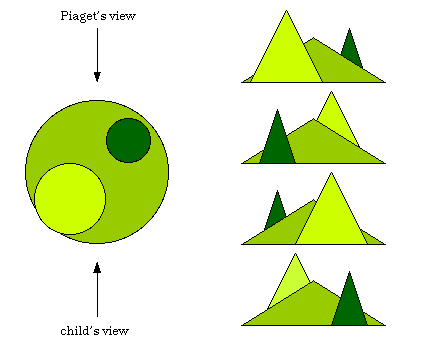
Before we proceed further, it is instructive to distinguish between perceptual perspective-taking or point-of-views as outlined by Piaget and more emotional-cognitive theory-of-mind perspectives as elaborated by Selman. The ‘impersonal’ point-of-view tasks that piaget used (for eg in the famous point-of-view task whereby a Christmas tree was obstructed from point of view by hills. See figure) rely more on whether one can literally see from the point of view of another person and is restricted to purely perceptual phenomenon. While egocentrism would correspond to undifferentiated perspective taking (stage 1) of Selman as it involves inability to distinguish one’s own perspective from those of others, Decntering would be akin to taking third party perspectives (stage 4) of Selman. Piaget’s decentration may be a necessary (but not sufficient say in the case of people with Autism) condition for the development of third-party perspectives stage of Selman.

Thus, in the ensuing discussion all references to perspective-taking would be in the theory-of-mind emotional-cognitive sense and not in purely perceptual terms.
Consider as an example a story presented to children who are then asked on what the protagonist would do and how others would react to it.

Holly is an 8-year old girl who likes to climb trees. She is the best tree climber in the neighborhood. One day while climbing a tree she falls off the bottom branch but does not hurt herself. Her father sees her fall, and is upset. He asks her to promise not to climb trees anymore, and Holly promises.

Later that day, Holly and her friends meet Sean. Sean’s kitten is caught up in a tree and cannot get down. Something has to be done right away or the kitten may fall. Holly is the only one who climbs trees well enough to reach the kitten and get it down, but she remembers her promise to her father

The first stage of Selman is based on Undifferentiated Perspective whereby one attributes one’s or protagonist perspective to everyone else’s. One may have a concept of perspective or Theory-of-mind but may suffer from an inability to attribute any other perspective to anyone else distinct from one’s own. Thus typical response are like “The child predicts that Holly will save the kitten because she does not want it to get hurt and believes that Holly’s father will feel just as she does about her climbing the tree: “Happy, he likes kittens”

This also relates to Kohlberg stage 1 in the sense that one comes to realize that one can have a ‘moral’ perspective on a subject. This ‘moral’ perspective though is undifferentiated from what the society has imposed in the form of rewards/ punishments . One confuses others moral perspective (father says this is right” with ones own “this is right” and sort of has an undifferentiated moral sense. Everyone should behave like this.

The second stage of Selman is the social-informational perspective whereby one comes to realize that not only there exits a perspective, but that it can be different for different persons. Nevertheless, despite the realization that the perspectives can differ ( based on say the different information that each may have) the preponderant tendency is to consider one’s perspective as valid and by exchanging information attempts to make others perspective inline with one’s own. Thus a typical response may be ” When asked how Holly’s father will react when he finds out that she climbed the tree, the child responds, “If he didn’t know anything about the kitten, he would be angry. But if Holly shows him the kitten, he might change his mind.” The attitude is typical of a person who realizes that someone may have a different perspective, but that perspective is not valid and is due to lack of information.

This too relates to Kohlberg’s second stage which is marked by self-interest and deal-making . One realizes that people may view things from different ‘moral’ perspectives, but also there is a preponderant tendency to favor one’s own moral perspective (that is based on self-interest) over others moral or ethical perspective. Thus there is relativism, but a relativism that is skewed by self-interest. Also exchanging or del-making as a way to align self-interest or different moral /ethical perspectives is the norm.

The third stage of Selman is marked by self-reflective perspective taking which marks the first empathetic perspective taking whereby one sees, thinks and feels from other person’s perspectives using first person. This is literally stepping in someone else’s shoes and truly seeing as if the situation concerned oneself. This not just a logical realization that someone can have a different perspective but also realizing that that perspective can be equally valid given the other person’s unique situation. Thus one thinks and feels like the other person and can both suffer and enjoy the outcomes of situations as they unfold from the other person’s perspective. The emphasis is on understanding. And empathy. Thus the typical responses like ” When asked whether Holly thinks she will be punished, the child says, “No. Holly knows that her father will understand why she climbed the tree.” This response assumes that Holly’s point of view is influenced by her father being able to “step in her shoes” and understand why she saved the kitten. “

This too relates well with Kohlberg’s third stage marked by interpersonal relations. When one has developed empathy and understanding, one is guided by ensuring that the dealings are ethical in the sense that they make people feel good , enable one to be viewed favorably by others (realized as a good and genuine person) and generally lead to good relations. Empathy and understanding leads to valuation of individuals as similar to oneself and thus equally valuable. All moral/ethical conduct is guided by the dictum of good outcomes and relations between all (and especially those closely empathized with) parties concerned.

The fourth stage of selman becomes possible by the appearance of third-party or ‘bystander’ perspectives whereby one has decentred in the emotional/cognitive personal sense and can see a situation not only from first and second person perspectives of interacting parties, but also from that of a neutral bystander. This includes the ability to keep multiple perspectives in mind at the same time. One does not see from this perspective and then from the other – one looks at the entire big picture or view and understands that different people are having different perspectives. Thus typical responses include “ When asked whether Holly should be punished, the child says, “No, because Holly thought it was important to save the kitten. But she also knows that her father told her not to climb the tree. So she’d only think she shouldn’t be punished if she could get her father to understand why she had to climb the tree.” This response steps outside the immediate situation to view both Holly’s and her father’s perspectives simultaneously. “

This also relates closely to the Kohlberg’s fourth stage marked by conventional focus on social order. The ability to keep multiple ‘moral’ perspectives in mind at the same time and the ability to abstract and construct a big picture from these perspectives enables one to come up with the concept of the social morality, or morality that is not governed by different moral perspectives of the participating actors, but is based on the effects these acting persons have on the big picture, the social fabric. Thus the criteria of any ethical actions is adjudged as to how it influences the social fabric – does it lead to maintenance of social order- the third party neutral moral playground and its rules – or is it subversive to it. This is as opposed to the earlier ethical thought and action based on interpersonal focus on individual’s morality. The stage now becomes more important than the actors.

The fifth stage of Selman derives form maturation of this to a societal perspective, whereby one realizes that the neutral third party perspective is not really neutral but influenced by the societal and cultural context in which the bystander lives and is reflective of those values. One realizes that one can have different neutral perspectives on a situation, each of which would be colored by the values that are dear to the social and cultural context in which the situation occurs and which dictate what a neutral perspective is. One may realize that some values are desirable and others are not and that the perspective that is informed by desirable values is more preferable. The typical response thus are “When asked if Holly should be punished, the individual responds, “No. The value of humane treatment of animals justifies Holly’s action. Her father’s appreciation of this value will lead him not to punish her.”

This too corresponds well with Kohlberg’s fifth stage with the emphasis on Social Contracts and individual rights. When one realizes that the neutral third party perspectives cannot be neutral with respect to the fundamental values and human (or cat in our example) rights that inform such perspectives, then one realizes that while one has societal duties in the form of maintaining the social order which allows for resolution of conflicts between individual moral perspectives, one also has a duty to ensure that the societal laws, mores, traditions are such that they upheld this rules and regulations that are best suited to the human condition. One not only has duties, one also has rights that one can expect from the social fabric. Here one may play with different social values before coming up with a set of values that one deems are amenable to making most interactions viewable from a neutral perspective. One discovers one’s moral self and takes activism other measures to ensure that ones moral sense is inline with external social fabric in which one lives.

There is an interesting twist to the whole thing. It seems that moving to higher perspective stages involves taking in more and more information to form ones perspective. This bodes well for the information age. As more and more information becomes available at our fingertips, and we realize novel methods of integrating that information to form better perspectives, our moral sense and actions should also continue to be on upswing.

Selman himself has compared his work to Kohlberg’s stages. I don’t have access to the article, but others may find it interesting.

More later on the qualitatively different 6, 7, 8 stages. (which I’ll have to work out from thin air!)

Moral dilemmas and what they tell us about moral development

There is an interesting article on Rationality Vs. Emotivity influence in moral decisions and a commentary on the same by Thinking Meat.

As per that article, different decisions are reached in a situation that mandates one to choose a life of one person vis-a-vis that of 5-6 other people, depending on how the situation and moral action to be taken is presented. The hypothetical situation is that of a train/trolley running on a track and 5-6 people unaware of the impending train on the tracks ahead.

In one version of the situation, you can press a lever to divert the train to another track, on which only one person is present, and thus save 5-6 lives by compromising on one life. Most people, when the situation is presented thus, opt for the option of pressing the lever.

In the second version, you can push another person on the track, so that his impact will slow the train down and thus lead to saving of the other 5-6 people down the track. In this situation people usually choose not to throw the person on the track. Also experiments have revealed that emotional centers of the brain are engaged while making this decision.

While some theorizing is going on that the (imagined) action of pushing is not preferred due to the emotional reality of touching and pushing someone to end his life and that this particular (imagined) feeling leads to the decision not to throw the person on the track, let us focus more on the rational or deliberative part of the decision making.

It would be instructive to get familiar with Kohlberg’s excellent Moral Development Stage theory for further discussion.

From the point of consequences , the two situations are the same. One life vs many lives and the choice lying with the user (you). Also, perhaps equal societal punishment or recognition based on your choice. Thus, any Moral reasoning employing piaget’s first stage or Kohlberg’s first stage focusing on reasoning on the basis of consequences or societal punishment/rewards does not solve the dilemma as to why one would act differently in two situations. In both situations, one may be guided by a ‘rule’ or social dictum like that ‘many lives are better than one live’.

From the point of self-interest and relativity(Kohlebrgs second stage), the dilemma doesn’t make sense as neither the one person that needs to be sacrificed nor the many other that will be saved are either you or related to you. So the dilemma doesn’t solve for a person on second stage. In both cases he should make the same choice based on self interest and that choice may be not making a choice (neither pushing the person, nor pressing the lever) and thus being saved of any consequences that result from the making of choice.

From the point of Conventional morality employing good interpersonal stage of reasoning (stage 3 of kohlberg) the question would now become rephrased as what a ‘good’ person would do. Also, in absence of information about whether the one person about to be sacrifice is ‘good’ or the 5-6 to be saved are ‘evil’ and should not be saved or vice versa, he has no rational basis to make decisions. The one factor that may influence his decision is the proximity of pushing a person down, which may not fit in with the self-perception as a good person and this may explain to a certain extent the skew towards not pushing a person to save lives of others. In this stage of thinking pushing a lever and pushing a person may have different connotations.

From the perspective of social order (stage four), this dilemma presents a challenge. Before deciding which way to act, one would need to deliberate on whether the social order demands that one life be sacrificed to save many more, whether one need to take life of someone to prevent deaths of many others (this can be framed as should a dangerous murder be sentenced to capital punishment) . Another deliberation can be what if all those whose life is at stake are innocent and differ only in the fact that sacrificing one innocent life early on can save many innocent lives later. This is the typical hostage scenario whereby you may have to release terrorists, in order to save an innocent life in the moment that is kept as hostage, only to discover later that this has resulted in many future deaths of victims of those terrorists. In such cases where one knows that one innocent life stands in balance for 5-6 innocent lives further downstream, one still has to make a decision and the consideration primarily is on what precedent it would set. How it affects social order. Would one start taking hostages often ? Thus, sacrificing one life may be the option chosen. These deliberations may lead to the insight that though it may be emotionally repelling one may need to push the person oneself in order to keep up the social tradition of saving maximum number of innocent lives.

From the point of Social Contract and Individual rights (the fifth stage), it may seem that the life of every single individual is very valuable and maybe equally valuable. One may gain insights as to the fact that no amount of property is as precious as even a single (human) life. If this dilemma involved a choice to blow the (goods) train that was carrying vast amounts of wealth in order to save all the lives involved, then one may choose that. As the question is currently framed, there is not much ground on which to decide whether to sacrifice one person or many others. One may deliberate on the greatest good for greatest number of people and thus chose to sacrifice one person, so that many others can see much more years. Again, one may take into account the fact that the one person to be sacrificed is child ( and has many more years of life) and thus needs to be saved in contrast to 5-6 people who are old ( and thus wont see much life). One may even employ the reverse analogy and see that one old man (who has vast amount of wisdom) needs to be saved as he is of greater use to humanity then a child in which one has not invested much. All these deliberations involve and individualistic regards as to the value of life and value of unrealized potential or accumulated experience. What is important is the reasoning involved.

I wont go to stage 6 (universal principles) as Kohlberg himself has sort of retracted the sixth stage, but would hint that from that stage the dilemma gets interesting with discussion of life as a means or life as an end coming into picture. This is mentioned in the original Boston Globe article and is what Hauser is elaborating on. As per Hauser, one may be utilizing a universal moral principle (like universal grammar of language) preceding any rational or emotive deliberation to resolve such conundrums. In this universal scheme Life as Ends may be more acceptable than life as Means. Framed this way given a choice between saving a child and saving an old man, one would always choose a baby (as he/she has more years of life (and end in itself) ) over the old person. Only when one treats Life as a means of achieving something (knowledge? ) one may value an old person over a baby.

But before concluding , I would like to link these stages of moral development with my own theories of 8-stage development.

The first stage is based on finding out rules of society and are authority based. The cognitive task is to find correct associations between behaviors and results (punishment/rewards) and find an accurate view of how the Reality out there is. A similar development process leads to attainment of Trust (knowing that rewards are in plenty) in child’s development in Erikson theory. In moral development one develops capacity to link consequences to actions.

The second stage is based on seeing things from ones own point of view and is based on self-interest. One realizes points of view of others , but does not empathizes and is more of a deal making attitude. The cognitive task is to choose for oneself what would benefit one the most. In eriksons framework this leads to Autonomy (will) whereby one can decide for oneself. In Moral Development this takes the form of graduating from society’s dictums to a relativist position whereby one can choose what is beneficial to oneself in the moral sense (that is what fits one’s morality). One develops the capacity to choose over different options/ viewpoints.

The third stage is based on focusing on how the moral decisions is governed by interpersonal relationships. Here concepts like ‘goodness’ , empathy, motives become important. One starts thinking in terms of effects ones actions have on others and vice versa. This cause-and-effect interactionist view that goodness is an end in itself and that what goes around come back governs many of the moral decisions. The Cognitive task is to understand and appreciate the effects of one’s actions on others. In erikson’s framework this takes the form of Initiative or Purpose whereby one tries to co-operate with others and either lead or follow to accomplish goals. In Moral Development this takes the form of realizing that one has the capacity to do good and one should use that capacity.

The Fourth stage is based on focusing on maintaining the social order. One again gets obsessed with societal laws and more, but now does not see them as rules to be followed, but norms which the society has and which are for the good of the society. Thus, these ‘good’ norms are internalized and ones moral thinking behavior geared around maintaining the norms so that society can function as a whole optimally. The concept of Social duty forms and one feels obliged to return to society what one gets from it. The Cognitive task involved are to understand that one is part of a bigger society, to understand the complexities involved in social interactions and to learn the fragility of social fabric and the need to preserve it as the social fabric is responsible for the large amount of learning that individual suffers by indirect means like observational learning. In Erkison’s stages one develops Industry or a sense of competence that they can also work as effective members of a social group. They learn to follow rules followed by their peers or self-imposed by themselves as part of games etc. In the Moral Development this takes the form of realization that one has some moral duties towards the society in which one lives.

The Fifth stage is characterized by focus on Social Contract and individual rights. On makes moral decisions based on the fact that one has voluntarily negotiated a social contract with others on ones’ own terms that have included a strong focus on enjoying some rights as part of that social contract. Here, Kohlbergs notion of roles may be appropriate. One plays with different roles (as a moral agent) that one has to play while living in a society and instead of playing the role that his society may demand, turns the tables around and says that I as an individual be;live in these moral rights and duties and that this is my limited social contract with the society. In a sense one has defined one’s role and negotiated a personal contract based on that role and feels that neither the individual nor the society-at-large is under any other moral obligations. The cognitive tasks involved are gaining insights into what moral action or thought that one believes in are and how one can consistently use those moral rules while living in a society. The discovery of a moral self is the culmination of these 5 stages of moral development. As an outcome one may end with a rigorous personalized set of moral rules. In Eriksons theory this is equivalent to the similar (ego)Identity achievement of a n adolescent whereby one plays with many roles before deciding on one that one plans to stick around with. In Moral Development this is akin to forming a strong, personal moral sense (self) vis-avis not having a particularly integral sense of having a personal moral sense / conscience.

It’s interesting to draw parallels here with my earlier posts on Cognitive Maps whereby in stages 6, 7, 8, if the development is not proper one may regress to earlier stages and suffer from pathologies like regression, fixation or displacement to out groups. I propose that if after achieving a moral self if one does not continue to develop along quantitatively different next three moral stages, one may regress to earlier dysfunctional moral stage when faced with stress situations.

What these 6, 7 and 8 stages of moral development are? Wait for the next mail!! A tantalizing hint that 5th stage may involve another way of achieving moral-ego-integrity (more akin to how moral sense develops in females as per Gilligan) and the 6th stage may involve literally stepping in someone’s else’s shoes as if you are that person and then resolving a conundrum.